

 Back
Back
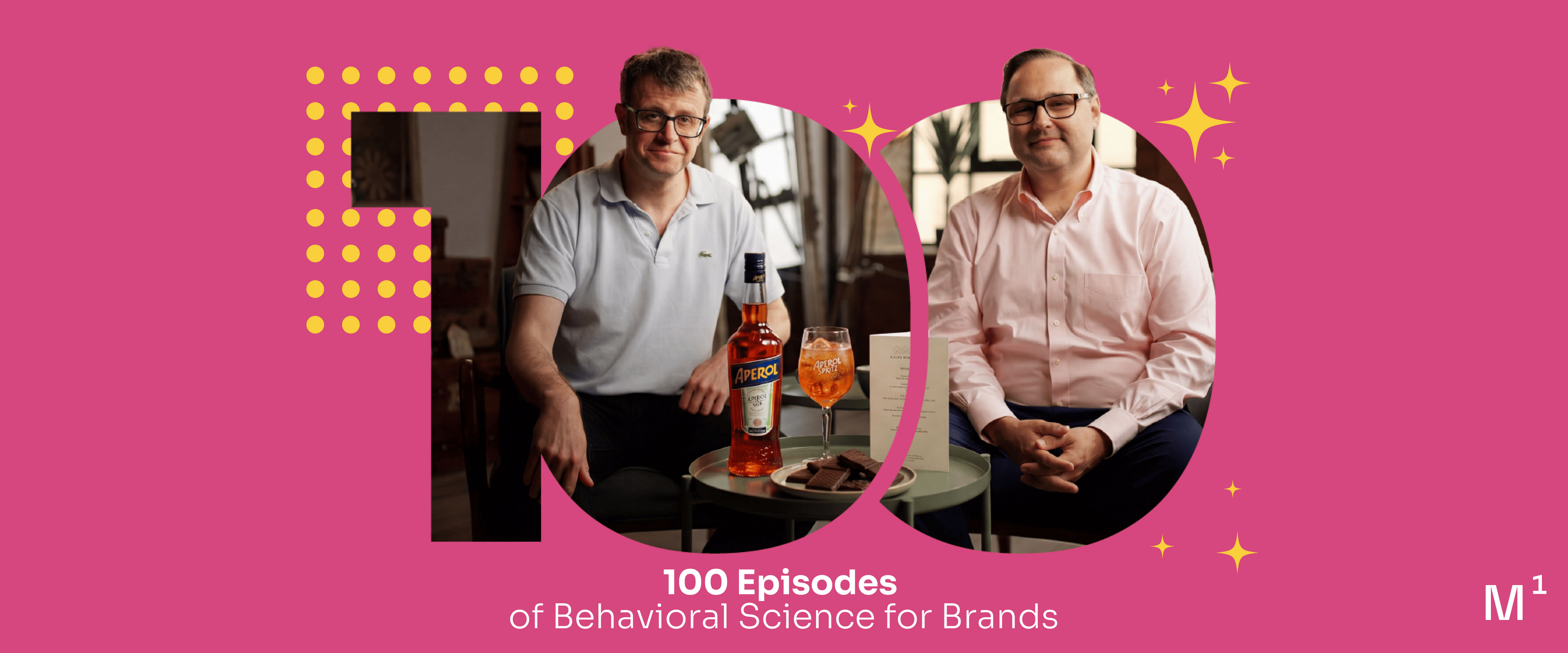
Straight from CBL: Celebrating 100 Episodes of the Science Behind How Brands Grow
Our Straight from CBL series features highlights from "Behavioral Science for Brands," the official podcast of the Consumer Behavior Lab (CBL). Co-founded by Method1 President MichaelAaron Flicker and Senior Behavioral Science Advisor Richard Shotton, and including Method1 Head of Brand Allison Arling-Giorgi, the CBL decodes how consumers make choices and translates those insights into practical strategies—the science behind how Method1 partners with challenger brands to create category leaders.
The CBL’s “Behavioral Science for Brands” podcast recently reached a milestone: 100 episodes exploring every marketer’s million-dollar question. What actually makes someone reach for one product over another?
Over five years, podcast hosts MichaelAaron Flicker and Richard Shotton have demystified the cognitive shortcuts and emotional triggers that drive purchase—and build household names.
The show is now ranked in the top 3% of all podcasts globally (Listen Notes) and became the #2 Behavioral Science Podcast in America (Million Podcasts), drawing over 15,000 listeners per month. Guests have included Dr. Charles Spence on multisensory perception, industry iconoclast Rory Sutherland on reverse benchmarking, and advertising effectiveness pioneer Les Binet.
Each episode investigates how successful brands grew by embedding behavioral science into their strategies:
- Episode 3 reveals how Aperol's distinctive orange color and balloon glassware made consumption visible and signaled popularity, a creative application of "social proof"
- Episode 56 explores how 11 Madison Park applied the "peak-end rule"—finishing every meal with a pour so indulgent, guests would never forget it
- Episode 60 explains how shape, sound and weight influence flavor due to "cross-modal correspondence”—empowering brands to upgrade what consumers taste without switching formulas
Many of these principles anchor Flicker and Shotton's book Hacking the Human Mind: The Behavioral Science Secrets Behind 17 of the World's Best Brands, now available.
They’re also the behavioral truths that drive Method1’s approach across creative development and media strategy. Applied systematically, the value of these proven principles compounds—building the memory structures and decision triggers that can speed choice at scale.
In their centennial episode, Flicker and Shotton revisit their favorite conversations—as in the excerpt below. Hear their thoughts on how uncertain rewards make consumers more interested in your brand and even willing to pay a premium.
And as you read it, consider: What psychological value could you build into your brand experience—without touching your product or your price?
PODCAST EXCERPT
The "Behavioral Science for Brands" podcast from the Consumer Behavior Lab
Episode 100: MichaelAaron Flicker and Richard Shotton on 100 Episodes of Behavioral Science, Brands and Ideas That Actually Work
Note: Transcript edited for brevity and clarity
Speakers: MichaelAaron Flicker (MAF), Richard Shotton (RS)
MAF: Richard, did you have some standout episodes that really got you thinking?
RS: Hearing the academics talk about their own research—I've always thought that was super interesting. And of all those episodes, the one that I really enjoyed was with Ayelet Fishbach. She talked a lot about her research into things like the “goal dilution effect.” But I particularly liked her discussion of her work with Luxi Shen around uncertain rewards [the “motivating-uncertainty effect”].
The study she talks about in the episode recruits 138 students. They are shown one of two bags of chocolates. Some people see a transparent bag with four chocolate truffles in it, and they bid how much they're prepared to pay. The average bid is 66 cents. Other people are shown an opaque bag and told it might have two truffles in it, or it might have four. This fresh group of people is asked how much they'd bid to take that bag home with them. And the average bid is more than double: $1.49.
Think about that for a second. You are selling people a worse product—or a cheaper product for the maker, let’s put it that way. Because on average, it's going to have three truffles, not four. Yet you’re able to charge so much more. The point that Fishbach made there was that people—especially with these kinds of smaller purchases—they love the excitement of an uncertain reward. They love the excitement of a gamble. Everyone wants to be a winner. By taking this kind of approach, you can add psychological value to your product that is free to create, rather than trying to add value by giving ever-more-expensive products away.
It's a principle we explored extensively when we put Hacking the Human Mind together—we talked a lot about uncertain rewards and how they can be used. So she was brilliant. I loved that episode.
MAF: I think it's a great reminder—especially if you work in advertising or just one type of marketing—that marketing in its classical form is not just promotion. It's not just price. It's also product and place. What is this thing you’re selling, and as Nir Eyal talked about, how does it meet a psychological need? And how does it meet that? What Ayelet and her studies reveal is that sometimes the satisfaction or intrigue has as much to do with what you think you're getting as what the actual product is.
RS: We've seen some lovely applications of this. There's an English curry chain applying this principle. For those who've never been to Britain, there's a smallish chain called Dishoom—a fancy curry house. If you go at an off-peak time, you can ask them to give you a key ring, a very fancy key ring. And then you go back at an off-peak time, at the end of your meal, you can ask them to bring out the “matka.” It's a brass jar with dice in it. You shake it, roll it, and if a six comes out, everything you've eaten, everything you've drunk—the whole table—is completely free. People go wild for this.
An accountant at Dishoom might say, "We're just giving people a 16-17% discount.” That's not that steep. Many restaurants give steeper, fixed discounts to fill seats during off-peak times. But by turning it into a game, introducing a bit of theater into the situation, you create value that isn't in the mathematics—it's not in the underlying utility of what's being offered.
MAF: It's what you would call big capital-B Brand! It's part of the brand experience at Dishoom, even if it has nothing to do with the food that you're eating.
RS: Yes, and the nice thing they do is give it an aura of relevance. Dishoom is designed to look like a 1920s Bombay restaurant. The board that comes out looks worn and has writing in period-appropriate languages. The matka, they say, evokes 1920s India. That takes the idea one step further—you move from just rolling a standard die on a bit of cardboard to those theatrical elements, the aesthetics, the design, that bring it back to the brand a bit more.
To hear Flicker and Shotton revisit more highlights from the first five years of "Behavioral Science for Brands," listen to Episode 100 in its entirety here.
To see behavioral principles in action building indulgence brands, explore Method1's work.

