Back
Back
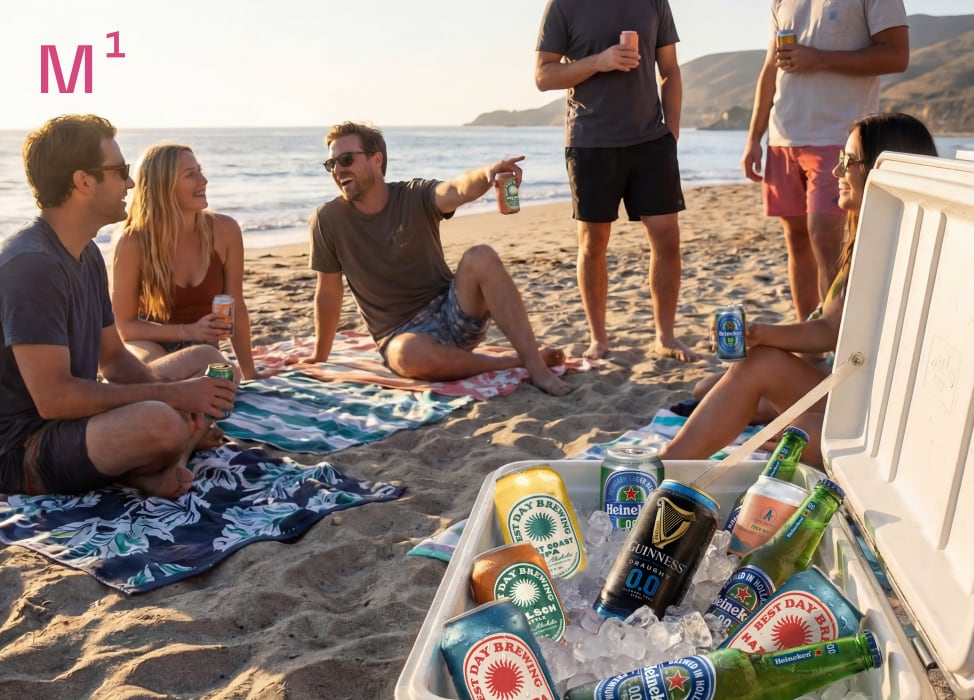
Expansion Beats Substitution: How Ambitious NA Beer Brands Are Building a $5B Market
January is when every NA beer in America makes its play.
Dry January gives people a reason to take a break from alcohol, and the category knows it. The Beer Institute calls NA beer the “King of Dry January.” 60% of consumers in their 2025 survey say no/low-alcohol brews help them meet their moderation goals.
As we see it, Dry January can give any NA beer a bump with the right campaign, media buys, influencer strategy. It's the one month when substitution is the whole point. I'm not drinking, so I'll have this instead.
But here's what's interesting about the brands we see outperforming in this space.
They’re more than happy to win January. But they're also focused on the other 11 months, steering well clear of any guilt associated with indulgence in a fine brew. How? By targeting all the occasions that don't come with a reason to avoid alcohol—because alcohol was never part of the equation in the first place.
Cross the finish line at an IRONMAN event today and someone hands you a beer. Specifically, Athletic's custom brewed Personal Record IPA—ready to be enjoyed on the podium. Nobody over-explaining it, and nobody calling it “near beer.”
It's just … a great beer. Enjoyed at a moment that used to be reserved for restorative Gatorade and protein shakes.
There’s a lesson in that for challenger brands at critical growth moments—along with an explanation for how NA beer is growing faster than almost anything else in beverage.
The Limitations of Seeing NA Beer as a Substitute
The standard explanation for NA beer's growth goes like this: Gen Z is sober-curious, Millennials are cutting back, wellness trends favor moderation. All of which is true, and all of which treats NA beer as a substitute for the real thing.
It makes some behavioral sense to go to market as a better-for-you alternative, which is why brands do it. People have a bias toward the status quo. Wellness goals, desire for mental clarity, social pressure—whatever's nudging someone away from alcohol, switching to something “close enough” feels easier than trying something new.
But here’s the problem: straight substitution has a growth ceiling built right into it.
If you're the thing people drink instead of regular beer, you're stuck competing for a share of existing beer occasions. Marketing yourself as a consolation prize that’s "almost as good as what you actually wanted."
The more ambitious NA beer brands share something notable: they don’t market themselves as option B. They’ve figured out where substitution ends and a wider growth path begins—in the occasions alcoholic beer isn’t always invited to.
Category data reinforces that something bigger than substitution is happening. According to IWSR:
- Between 2019 and 2024, US NA beer volumes surged 23% while the overall beer category declined 3%
- NA beer shows 175% absolute volume gains since 2019
- Growth forecasts predict 18% CAGR through 2029
That's not share transfer. That's category creation. And with NA beer still at just 2% of total beer sales, the runway ahead is enormous–especially if your marketing plan includes raiding other categories.
The Opportunity in Expanding the Map
Countless occasions have a drink-in-hand expectation baked in—something to sip, something to hold while you navigate conversation. NA beer meets that need without the fog or mental math of choosing alcohol when it could be socially iffy (or, let’s face it, when it would be illegal).
Stop tying yourself to "drinking occasions" alone, and territory opens up fast. Now you're stealing from more than the beer cooler. You're stealing from sparkling water, from soda, from empty hands.
Solid behavioral science explains how this works.
Occasions function as “context cues”: environmental triggers that are proven to drive consumer behavior. When a brand builds associations with a specific occasion, the moment does the marketing—and the choice feels effortless.
Triggers like this are critical for indulgence brands, which face an extra barrier: the consumer’s need for permission to enjoy something non-essential. Linking any beer to a consumption occasion helps bypass it, making purchase measurably more likely.
Expansion Strategies in Action
Four brands are showing us how occasion strategy plays out at different stages of strategic planning and growth.
Occasion Ownership in the Making
It can take time to work your way into occasions for your consumer. We see Tom Holland’s new brand BERO as having started that journey.
In its first year, BERO claimed an interesting context for any beer: luxury. They've hosted events at Wimbledon, stocked Chase Sapphire lounges and lined up an impressive partnership with Aston Martin. Next, we expect campaigns that translate that premium positioning into occasions that consumers and the brand can own together.
The credentials are all there. The moment’s just waiting to be claimed.
Occasion Ownership from Day One
Clear category leader Athletic—valued at $800M with roughly 20% of the market—was born to own moments of achievement. The name. The IRONMAN sponsorship and partnerships with fitness influencers. All of it signals indulgence that’s earned—one of the most successful kinds. And because there’s no penalty, it’s a reward you can enjoy “seven nights a week” just like Founder Bill Shufelt intended.
“Powered through another grueling Tuesday? Drink us at your daily finish line.”
Close behind is Best Day Brewing, the category's #2 pure-play, building in similar territory through grassroots activation. As co-founder Mike Sheehan put it, "If they're the Coke, we're the Pepsi."
The difference? Best Day earns awareness on the ground–as the official NA beer of Life Time fitness clubs and the Professional Pickleball Association. They show up at your winning moment rather than advertising about it.
“That was awesome. You thirsty?”
Occasion as Opening Move
Heineken 0.0 played the long game. Launch campaigns in 2017 claimed specific occasions, notably including the workday—showing an exec cracking one open in a boardroom. But once they'd built trial and share through those entry points, they expanded the map again with their 2025 Dry January campaign, "0.0 Reasons Needed.”
First they granted wider permission to indulge in an NA beer. Now they're destigmatizing the choice entirely.
Of course, product quality still matters. Athletic beat 500 beers, most of them alcoholic, on flavor at the International Beer Challenge. Guinness, practically its own category, initially grew by leaning hard into substitution with the amazing Guinness 0.0—so good, Irish pubs went from 250 to over 2,000 locations serving it on draught in under two years.
But that’s the point for brands making their growth bids now.
Thanks to these uncompromising trailblazers, "surprisingly good for NA" is no longer enough to be:
- Distinctive
- Memorable
- Top of mind when it matters
The next wave of growth in this fast-growing category runs through marketing—brand storytelling, creative and media—with occasion strategy as a rich approach that most haven’t seriously explored.
The Unclaimed Territory
With NA beer still at just 2% of total US beer sales—while driving the $5 billion no-alcohol market projected by 2028—there are still countless opportunities to acquire new consumers by owning new occasions.
Consider this.
A full 61% of NA beer consumers are now Millennials in their prime parenting years, ages 28-43. Our analysis of MRI-Simmons data sharpens the picture: these consumers aren't just more likely to have kids, they're nearly twice as likely to be buying infant formula and baby food. Their children are young—when keeping alert matters most.
The preschool graduations. The birthday parties and play dates. The Sunday barbecues with families from across the neighborhood that last all afternoon. They’re all wide open.
As we see it, the market is full of unclaimed ground:
- “Miles to Go” The road trip with friends, the scenic solo train ride, the long flight where you want to arrive fresh instead of foggy.
- “The Long Game” Poker night, fantasy draft day, the marathon tailgate you wouldn’t dream of checking out on early.
- “Perfect First Dates” The showing up clear-eyed for that amazing new person across the table, committed to being present for whatever comes next ... with a brew that becomes “ours”.
These are mainstream moments that take place all the time, in every city and town, to millions of people who would love to taste a great beer right now.
They just need a brand to connect to the occasion and trigger permission to indulge in the pleasure.
What Owning the Occasion Requires
Strategy without execution is just a good idea that never pays off. But nobody could blame your CFO for asking, “What am I allocating spend here for, exactly?”
Holistic activation is where occasion strategy connects to business strategy. Where positioning decisions become go-to-market decisions. Where applied behavioral science—starting with your powerful context cue—gets operationalized across touches.
Making an occasion yours takes:
- Brand identity that evokes the moment, not just the category. Distinctive brand assets and messaging that signals, "This beer is for times like this."
- Creative that puts the product in context. Less focus on taste claims, more on the scene: the poker table, the open road, the moment she notices what you ordered for getting to know her.
- Media that reaches people in the right mindset. Think airport OOH for the traveler about to board and podcast spots for the parent folding laundry at naptime. For brands with global ambitions, NA opens sponsorship doors in markets where alcohol can't advertise at all. (Ask anyone who's navigated alcohol restrictions in global motorsport how valuable that freedom is.)
- Creators who live and breathe your moment. Recommendations from influencers that feel like advice from a trusted friend, not a sponsored post.
- Consistency that builds the association over time. The same occasion, the same visual cues, the same story told across every touchpoint until the moment and the brand become inseparable.
When these elements work as a system? Effectiveness compounds. You become truly unique and memorable. And when your moment arrives, every behavioral trigger you’ve embedded drives choice at scale.
To Accelerate Your Growth, Claim Your Occasion
It's still hard to believe that not long ago, buying NA beer meant opting out of something. Today, it means something else. Because early innovators multiplied the moments beer comes to mind as the perfect indulgence.
The category is young enough for new leaders to build on that expansion and grow quickly. The brands that stake claims now could own specific moments for the next 20 years while the ones leading with "great taste, no alcohol" will spend those years trying to catch them.
This Dry January, take a break from thinking of NA as a category with a ceiling.
Expand when and where consumers think of you and reach for you. That's how you grow from “a solid NA option” to your consumer's beer of choice.
All 12 months of the year.
To see how owning the right moments drives growth, explore Method1's work.
About the Author
Paul Nelson, Managing Director at Method1, brings three decades of marketing and brand-building experience to building irresistible brands. A true champion of behavioral science and bringing moments of joy to people’s lives, he has played a role in driving success for notable brands like Elijah Craig and Evan Williams bourbons, Ocean Spray, Hershey’s, Lunazul Tequila, Cape Tide Hard Tea, Jack Daniel’s and Sam Adams.

Ready to
make your brand
irresistible?